Showing posts with label Japanese culture. Show all posts

20.6.10

Balance


Balance is the latest installation piece by artists Dwayne Bohuslav and Joanne Brigham, who together perform as Moving Bodies.  Their art typically addresses the most primal aspects of our existence and that of our planet, here using the theme of vernal equinox for a show that opened on the date thereof.

Though their themes are often primal in nature, addressing topics such as ice, human instinct, myth, and habitation,  their palette of materials is a modern one that attempts to reconcile these ancient themes with our modern lives, and discourage our ever increasing distance from a life engaged with the planet.

Many of their pieces are designed by Bohuslav, who is also an architect, and occupied by Brigham for a performance of her sound works.  This synthesis of space making with occupation encourages comparisons to the primitive hut, which is furthered by the ad hoc quality of the workmanship and which again attempts to reconcile modern life with our roots, just as it first did in the writings of Laugier in the 18th century.  That the installations are opened as a performance, a movement from within, rather than object installed in space for our consumption as is typical, demonstrates to the viewer our connection to these themes by showing how they may be occupied.  Past themes have allowed for the art viewer to be art participant, as they were encouraged to walk through elevated constructions where they set off sonic constructions and lights through motion detectors.


This piece, Balance, while scoring the vernal equinox in its tilted frame, also took inspiration from the Japanese Tale of the  Bamboo Cutter, which tells of a baby girl found inside a bamboo shoot and ends with her return to the Moon, from which she originally came.  The story of  something/someone from the earth returning to the heavens is a common theme through the ages, and exemplifies  our desire to make sense of our place in the realm of things, and reconcile our life on this surface with the sky above.  The scale change in the Japanese story, from bamboo shoot to Moon in the heavens, is typical of Japanese philosophy that finds equality between the tiniest detail and largest gesture.  In the Bohuslav work, one finds a massive structure overhead giving birth to small suspended bottles, scaled to ones hand, and making sense of "balance".


Many of the works by Bohuslav and Brigham are suspended from above with the viewer passing beneath, so that present in these pieces are representatives of the earth and heavens, thereby posing a meeting of body and mind, instinct and learned, and in the end, an articulation of our presence on earth.

8.5.10

Japan musings 5

Where in the west, and perhaps most of the rest of the world, things are fastened and secured through a direct, center oriented, confrontational relationship between 2 objects, in Japan, those same two objects are secured through tangental, peripheral relationships.  That Japanese culture and being is grounded in notions of de-centering, favoring the peripheral over the centered, is central to understanding not only the Japanese way putting two things together, but also understanding their relationship to nature.  This pervasive and simple notion, observable throughout Japanese culture, and noted over and over in these musings, is the beauty of the place, and not to be found anywhere else in the world.

When you walk through a Japanese garden or temple or manor house, you will observe that no two objects are put together against their will (yes, objects have will).  They will instead be placed adjacent to each other such that each maintains its integrity and self, and thus exist in harmony with each other, and by extension establish harmony throughout the construct.

In these examples of Japanese fences, you can see that the members are allowed to slide by adjacent members, with each component serving its own function, but not in such a way that it becomes subservient to another.  The fences, when wood, are rarely set into the earth by digging a hole and setting in a post, but rather they are often set onto a stone wall or base, which itself is set into the earth as a stone might naturally do.  This is practical, as the wood is kept from the moist earth, but also establishes the same hierarchy held by nature, thereby ensuring the small piece is in harmony with the much larger whole.


The same phenomenon, that of component pieces passing by each other yet bound to create a new whole, can be seen in the wood framing of temple roofs, where the Japanese developed a sophisticated language of wood joinery.  Wood joinery, of course, exists all over the world, but in Japan it is consistent with a prevailing attitude toward design in general, and so takes on special significance.


The example above shows clearly wood members passing by other members in order to create a hierarchy of support and structure.  This passing doesn't occur without one member acknowledging the other; one member receives the other in such a way as to address one or more of the forces acting on the whole: compression, tension, bending, and shear.  The example above is interesting because it shows two beams that appear to be coming out of the corner post, or attached to it.  In fact, these beams are passing by the column (the beam is in fact 2 pieces), but internally their anatomy's are interlocked such that they become one being, allowing forces to be transferred from a horizontal member to a vertical one.  Notice also the diagonal beam, which is in fact two beams joined together, and how the tiny gap between them articulates the line created by the intersection of the beams below, as well as the corner of the column.  This articulates a larger truth, that of the comfort the diagonal has as in the Japanese orthogonal realm, which is nothing more than a restating of the presence of typhoon, earthquake, volcano, or other divine intervention to mans imagined ordering of the world, and the Japanese acceptance of this in their design vocabulary.  In the west in particular, the diagonal is an alien presence, and is usually only awkwardly addressed.


22.4.10

Japan musings 4


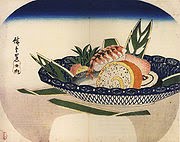
If you didn't know what sushi was, you probably wouldn't eat it.  Many know what it is and that's reason enough never to touch it.  Sushi doesn't really look like "food".  It inhabits strange territory that only the Japanese could have invented, and is very much a product of the Japanese attitude and relationship toward nature, and reinforces the preceding discussions about the formal structure of Japanese culture.

The invention of sushi involved the reconciliation of land and sea, a reconciliation that might describe Japan itself.  It was found that fish could be preserved if it were wrapped with rice that was allowed to ferment (along with salt).  And so fish, one of the staples of the Japanese diet, was married to the other staple, rice, which was produced inland.  The result was something that phenomenally reinforced the edge over center, as if to declare to rice that land will not own our cuisine, and to seafood that the ocean will not be central, either.  The interstice, the coast, will be our center.


The combination of fish and rice did not proceed without changing the nature of the fish or the rice.  The fish lost its fishness; it is no longer identifiable as such.  It has been sliced into an abstract of both size and form, and its canvas is rice, which must now be self supporting.  Often sticky, the rice may assume the form of the fish, or it may be bound together with the fish by a band, also eatable.  The new creation is not cooked but is raw, with the shiny flesh of the sea creature showing itself to the world, and the granular cloud of white grain beneath, as if soft bones clinging to each other.  Sushi declares itself not fish, not rice.  Its a new species, only minutes from life, served with brethren equally alien, from both land and sea.


This remaking of nature in mans image in not a new idea.  The history of the garden is the history of just such remaking.  But in Japan this remaking is allowed its own realm, where the remade version is understood not as mans interpretation of nature but as the nature of nature.  It is the essence of nature; more nature than nature.

Kani miso              ©Hiromi Kikuno

©Hiromi Kikuno

14.4.10

Japan musings 3

Last weekend i was in DC, but missed the Cherry Blossom festival.  There were still a few pink shiners around town, but for the most part they were gone.  And thats the nature of the cherry blossom, it flowers for a few days, then its poofed.  As you probably know, the cherry trees were a gift from Japan to the US in 1912 to symbolize friendship between the two countries.

Cherry blossoms carry great cultural significance in Japan.  Hanami is the name of the celebration of the blossoming of these trees, when the people of Japan go out for no other purpose than to enjoy the sight of these trees in bloom.  If you've read the previous musings on Japan, you can see where this is going.  The Hanami is another aspect of Japanese culture that exemplifies the celebration of the moment over the eternal, rebirth over extended life, and the certainty of change.  One might say it's finding the eternal within a moment.  That beauty is found and celebrated in the short flowering of the blossoms is characteristic of Japanese thought, where there's a cultural recognition that a moment may give rise to a new Era or the destruction of a foreign fleet of invaders.  So, is it the beauty of the blossoms that is celebrated, or is it their transience?  There are many beautiful flowers in Japan.  I think without a doubt it is the transience that is celebrated, and its not a leap to think of the blossoms as the visual equivalent of haiku, as they are both celebrations of the moment and the ephemeral.  In the image below, so central to the psyche of Japan, we see celebrated the moment in two of its three aspects; about to pass, and pregnant.


i love that the Japanese 100 Yen coin has on one side a depiction of cherry blossoms.  Isn't money the perfect vehicle for transience?


It probably isn't polite to mention that many kamikaze pilots would have painted on their planes imagery of cherry blossoms, but its not irrelevant, either.

Since i'm in this discussion about the place of the moment in Japanese culture, its hard not to mention their attitude toward the camera and the snapshot.  It doesn't matter where you are, if you live in an interesting enough place that is subject to bus loads of Japanese tourists, say in Paris or Rome, you've seen them pull up, unload the tourists, tourists zoom out and take group pictures, get back into the bus, and pull out to the next destination.  For some reason i thought this happened only in Europe, after having traveled half the world, but when i went to Japan i saw it to the nth degree.  The big difference i noticed between the way most tourists photograph a tourist spot and the way the Japanese go about it is the importance the Japanese place on placing themselves in the picture, as opposed to simply taking a picture of the attraction and cutting out the people as i would do.  i like to think of this phenomenon as related in its psychology to that of the Rising Sun.  Japan is the "Land of the Rising Sun", as one can see in its flag, but this description is interesting with respect to the displacement it conjures.  For whom is it the land of the rising sun?  If you are in Japan, an island floating in the sea, and you are on the east coast standing on a beach early morning, you will see the sun rising in the east, but you will not yourself experience a rising; you are separated from it by perception, and will experience only the sun rising.  If you are in China (Korea), however, the sun rises over a land to the east, and so this land may be witnessed as a land of the rising sun.  This displacement is central to the Japanese psyche, and so reinforces the notion i mentioned in an earlier musing of the Japanese aversion to "center", and shows that even where you might think they have accepted a notion of center, as in their flag, within itself one finds it is in fact a center removed.  Thus the tourist, and pictures of themselves.

29.3.10

Japan musings 2

It's interesting to look at one of the most famous Japanese prints made by the artist Hokusai, and here find relevance to the idea of the vacant center, which i referred to earlier.  The print i'm referring to is "The Great Wave":


Whats interesting for me about this image is the way the wave implies a circling of the mountain in the background (Mt. Fuji).  Its not a circle completed, but one implied, and it has an interesting relative in the 5 yen coin, where a rice shoot is shown to be bent in the wind, creating, or reinforcing, the vacant center.


And what is the "vacant" center in the print?  It is Mt. Fuji, the spiritual center of Japan, and perhaps its primary symbol.  This print verifies the central role a "Great Wave" has in the history and making of the Japanese nation, as i alluded to in the first post, but beyond this narrative, there is another layer of information contained in this print that alludes to the fundamental quality of Japanese being.  If one looks again at the print, Mt Fuji appears as any other mountain, but it differs greatly in its formality.  Mt Fuji is a volcano, and as such may be said to be "empty" in the sense that it is but a conduit for the molten center of our planet.  If one were to look down onto a volcano from above, Mt Fuji might appear as the coin does, with an empty center and full perimeter.  In this sense, a volcano is the ideal iconic image of the history and collective experience of Japan, as it is simultaneously at peace in its harmonious, singular composition, and menacing in its reality as a volcano.  It duels with itself in appearing to be central while simultaneously denying center, or rather presenting center as something empty, vacant.  Many of Japan's sensibilities and customs come from this tension between center and perimeter, order and disorder; where often the perimeter is activated by en emptied center, and as i'll later demonstrate, the appearance of "empty" is anything but.

Roland Barthes explored this notion in his musings about Japanese train stations, which in his mind were the genuine "centers" of Japanese cities, rather than the Town Halls, Squares, and civic buildings of western cities.  He noted that the train station, which was generally full of people and thus heavily populated, was in a constant state of flux between emptying and filling, much like a heart, filling with blood only to send it away.  This state of flux makes it a very unique kind of "center" as it is one that does not hold its contents, but expels them, both inward and outward.  It is a center that exists in and celebrates the moment, the moment of arrival and departure, rather than the passing of decades and centuries.  This celebration of the moment over what elsewhere might take the form of a collective salute to history is also a very Japanese notion, and not unrelated its inclination to reset its calendar, or design with an acknowledgement of disorder, upon the arrival of epic "moments".

18.3.10

Japan musings

For much of its history, Japan has been isolated from western influences, with the exception of 200 years between the 15th and 17th century, when the Portuguese "discovered" Japan. Japan closed this opening in 1639, and it wasn't to open again until the arrival of Commodore Perry in 1854. The result of this relative isolation is an incredible unity of thought and purpose that crosses all aspects of its culture, and which struck me dumb when i visited in the early 90's. i plan to ramble about many of the visual aspects that struck me, and no doubt you will recognize the thoughts of others, such as Bataille and Barthes, though i've forgotten which are the pillaged thoughts.

Japan is a "frame" culture, as can be said of American culture.  But the idea of frame in Japan is very different from that in the US. Whereas the American frame is one of extension and allowance, it doesn't deal well with disruption, and is averse to variation, though of course has had to allow for it. The American "frame", if one is to think in these terms, is also very "center" oriented; the Japanese frame not so.  The Japanese "frame" culture is one that celebrates the interruption of the frame, and relishes these interruptions as though works of art. As it must. For Japan exists in the ocean, at the edge of a tectonic plate, and so has a history pierced, and to a degree defined, by natural disasters in the form of earthquakes and typhoons. These cataclysmic events are not welcomed per se, after all they are cataclysms, but they have been "let in", and one could say the aesthetics of Japan are partially characterized by a "disaster mentality", a mentality that from a formal standpoint favors the perimeter over the center, and celebrates interruption of the standing order, the flecks of disorder. The traditional Japanese calendar, for example, is marked by eras, most of which are defined by the arrival of a new emperor, but some of these eras are defined by the occurrence of an earthquake or tsunami, at which, in one sense, the calendar is "reset", and a new era defined.  Thus a natural disaster, a disruption of the established order, is celebrated as the birth of something new, rather than the demise of the existing order.

From a formal standpoint, Japan is all perimeter. It is a number of islands with a variegated coastline and high, dense mountains. The "center" does not want to be occupied. And so most of the population has lived on or near the coastline, and the Japanese people have long favored fishing over agriculture and animal husbandry (fishing can be seen as the taking from without, farming as a taking from within, and so it involves a "reach", a distention from the self, the home). Even the production of rice, which is central to their diet, involves the creation of many small "seas", or paddy's, which i will discuss again later. This notion of favoring perimeter over center can be seen throughout Japanese culture, from the treatment of packages to the presentation of their food, and from their way of greeting to the way they build their temples.  It permeates everything, but this is not the most interesting feature of the Japanese "sense"; what is most interesting to me is the consistency of this feature as an aesthetic, as if it were a gene all Japanese are born with, a folklore passed on through generations, and the amazing ability of this aesthetic to extend throughout Japanese culture, from teenage fashion to fortress walls.


More to follow...

LinkWithin

Related Posts with Thumbnails